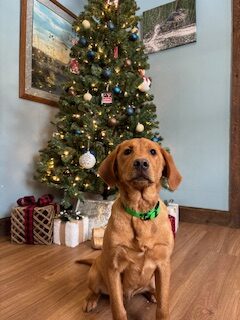
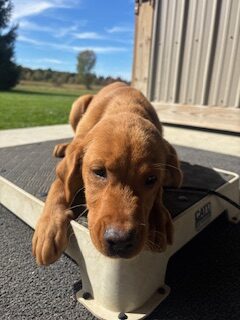
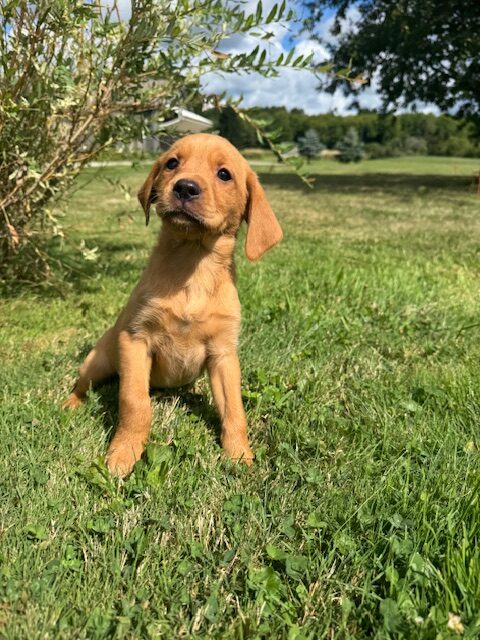
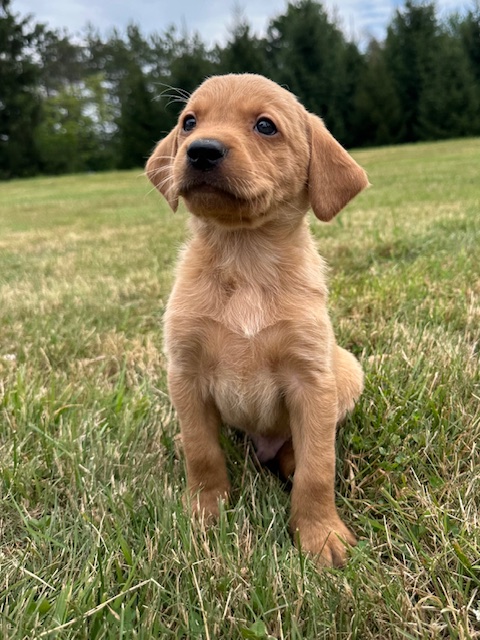
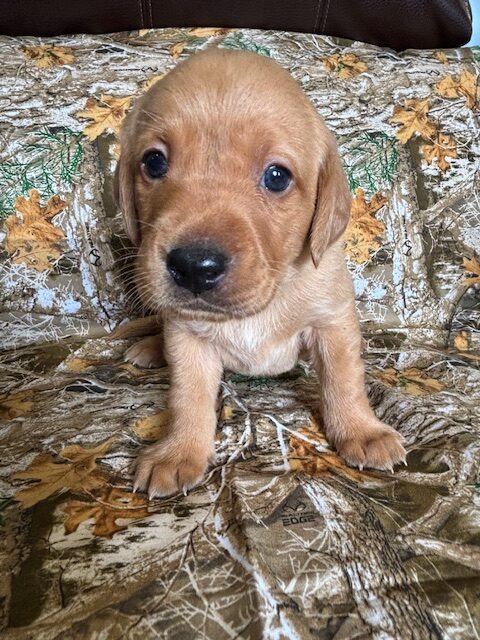
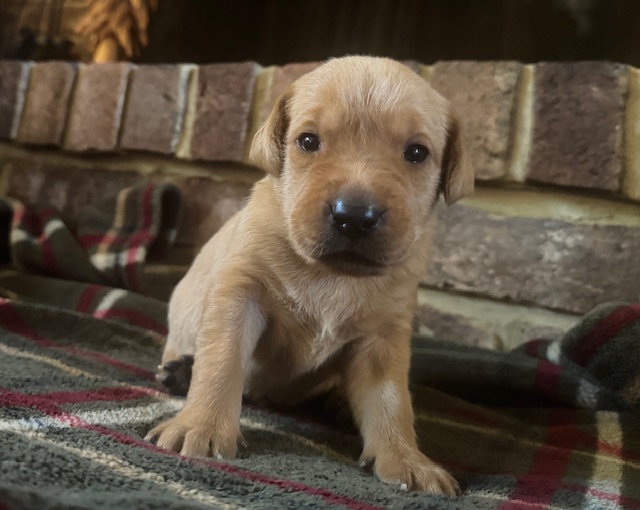
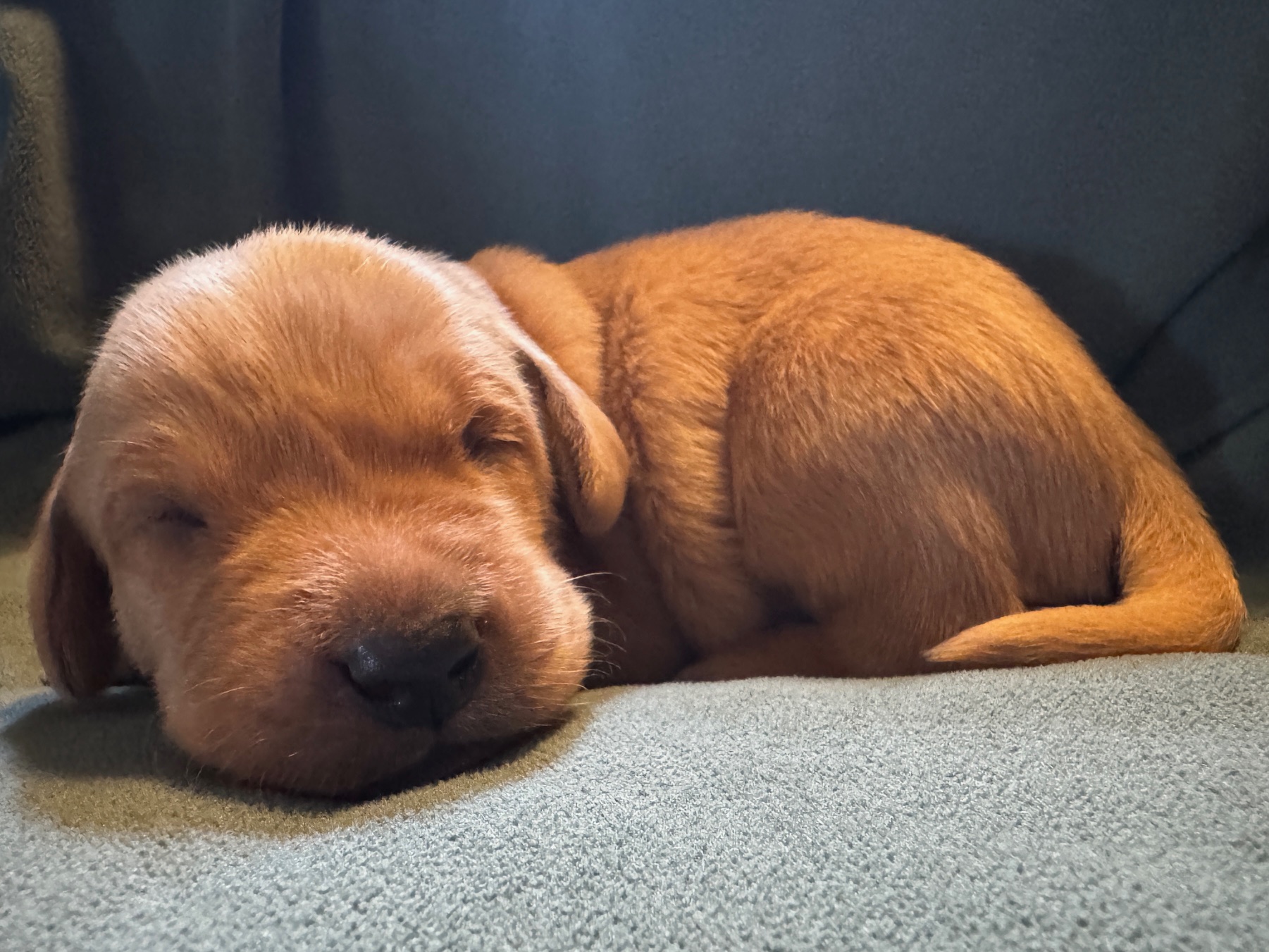
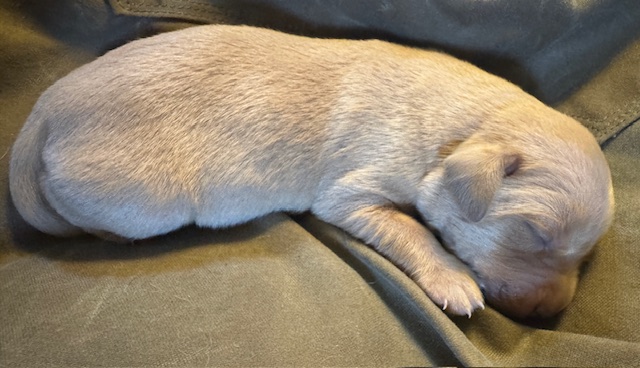
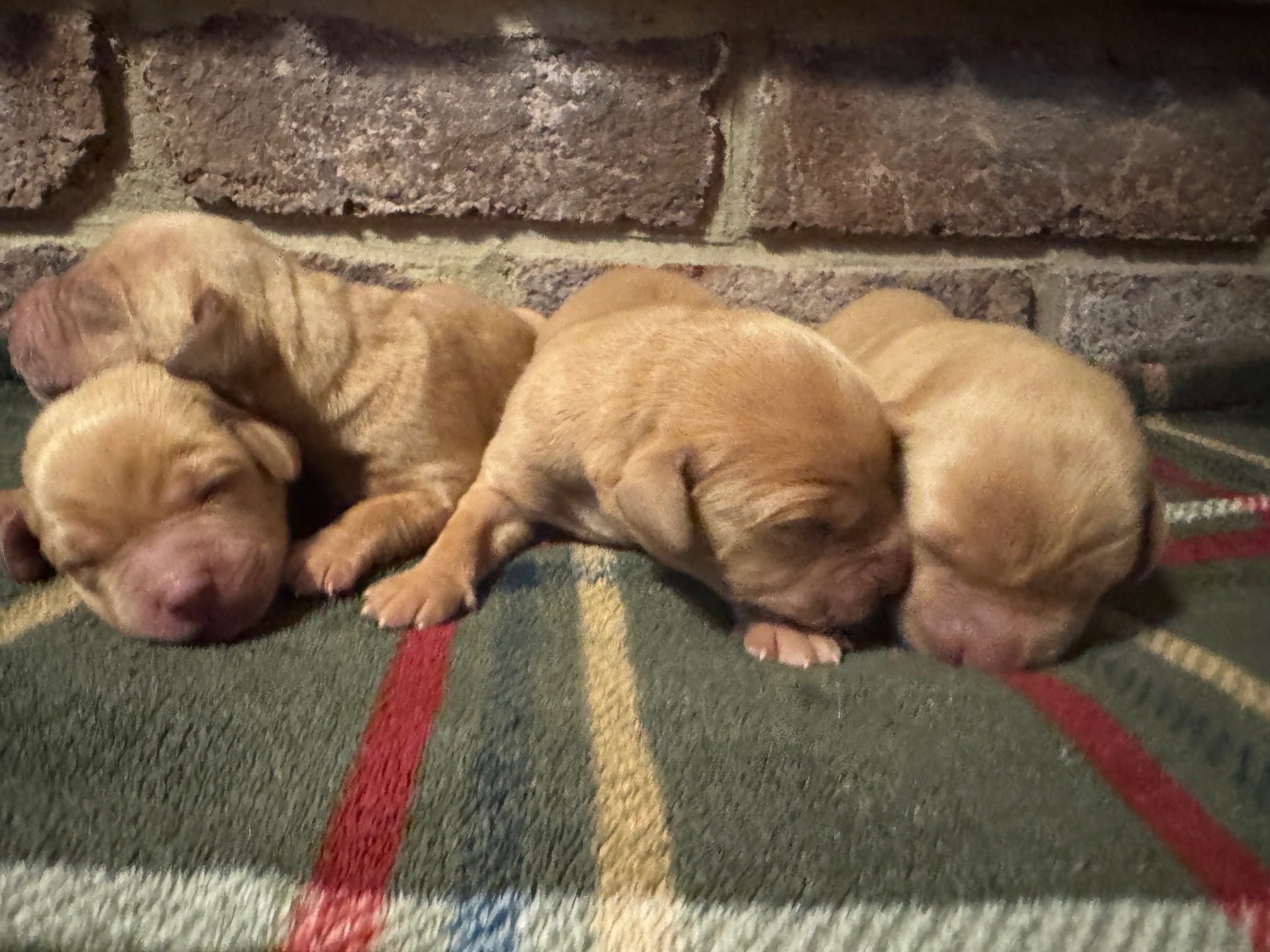
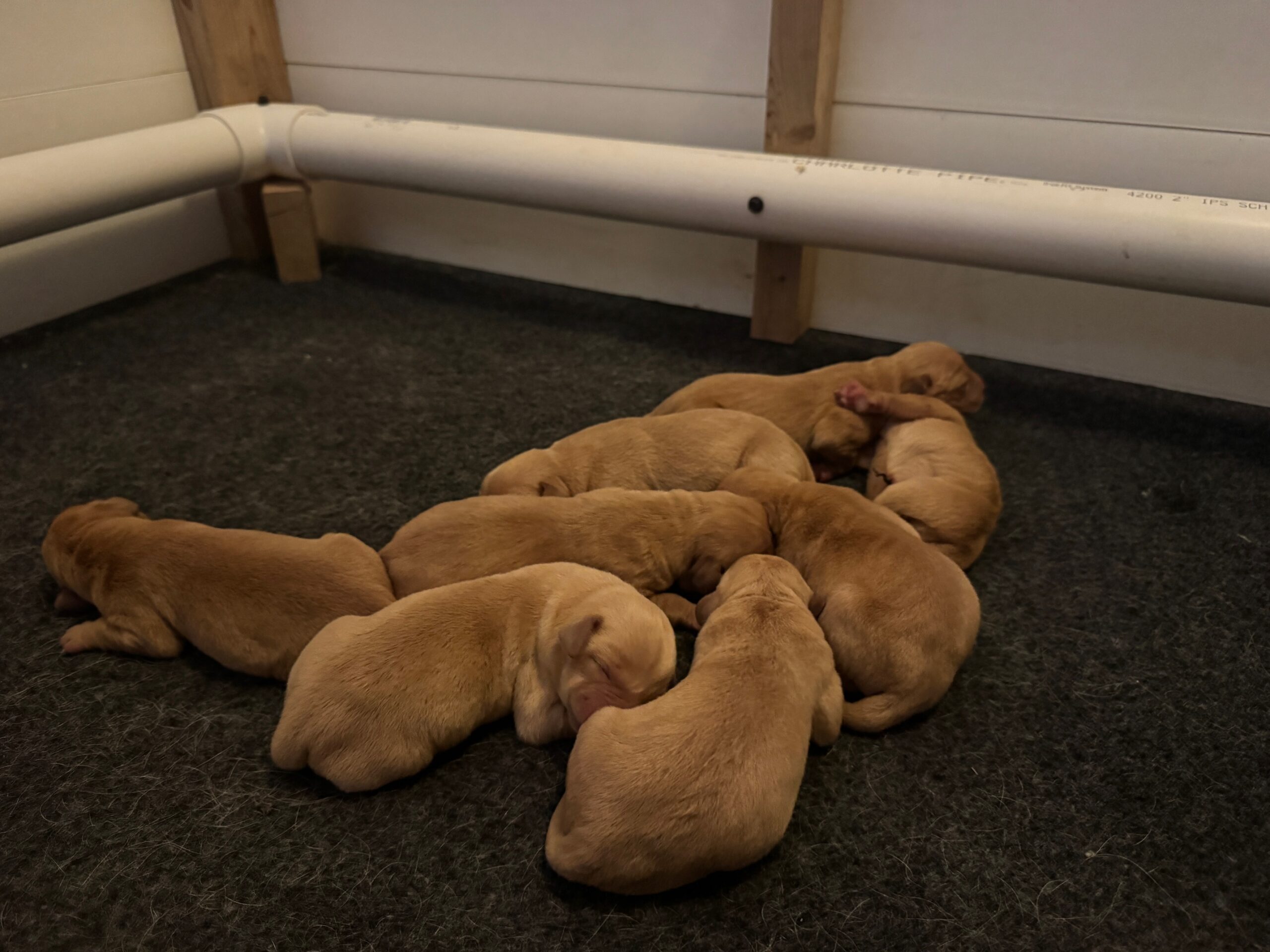
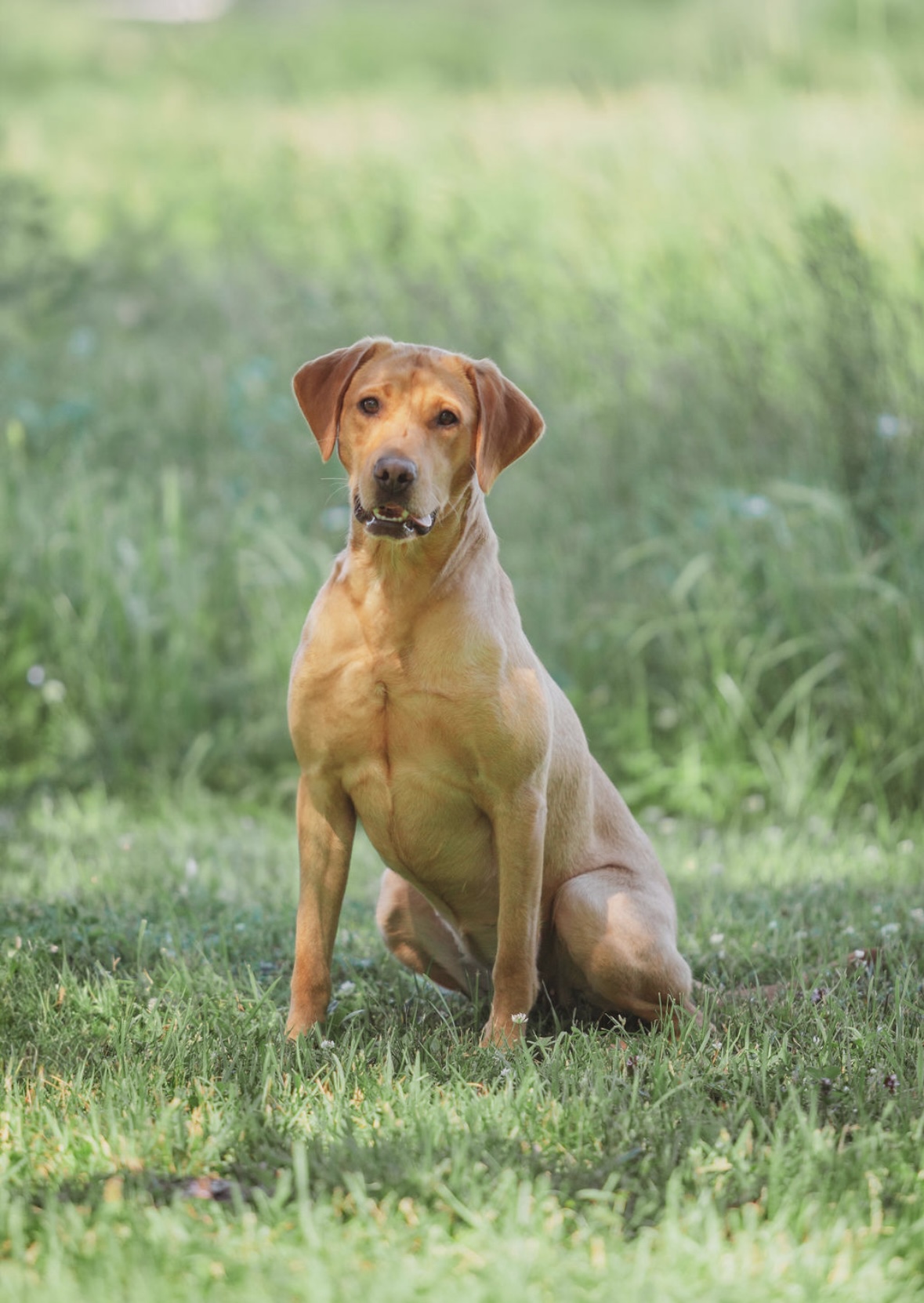

" Jack Hudson" Sold
Sire: FTCH Arcklebear Caribou " Ted"
( OFTW Cynhinfa Jarmen of Wauniago x FTCH The Windbreak Whisperer of Arcklbear )
BVA Hips: 0/1 , BVA Elbows : 0 , Eyes : certified
Dam: Sundance's Hannah Montana CGC " Hannah"
(FTCH Mitforton Oscar of Leadburn x Sundance's Culiann Kate)
Pennhip: Right DI : 0.39 Left DI: 0.33, OFA Hips: Good, OFA Elbows : Normal OFA Eyes : Certified
EIC,CNM, DM,HNPK,PRA-PRCD,PRCD,DRD1 ,OSD1, RD/ OSD,SD2 and STGD1: Unaffected
Pedigree
DOB: June 28, 2025
Yellow Male
To be trained as: Advanced companion
Go home date: march 7th 2026
Notes from the trainer~ Ema
I am really proud of Jack; he is doing great with his training.
What is your dog eating, How Much, and When?
When your dog goes home he/ she will be eating around 3 cups of food a day ( if your dog is eating a different amount, we will go over this at pick up) It's important to know that this amount will change during your dog's lifetime. You will need to feed more or less as your dog gets older, based on their activity needs.
We normally feed in the morning around 7:30 am.
Under a year old: Nutri Source Large Breed Puppy
Over a year old: Nutri Source Adult Chicken and Rice
* Available at Tractor Supply ( online), Chewy and Amazon.
* While in training your dog may be eating : Chicken & Rice, Beef & Rice , Trout & Rice etc. Please check to see what formula your dog is currently enjoying prior to pick up
What does your dog need to have at home ? Est. Crate, ID Collars and training Collars Size...
Medium to Large Ruff Land Crate ( Please see our Recommendations page )
Collars and leashes that your dog is exposed to and uses during training :
17 inch ID collar , with six foot clip on leash
22-24 inch training collar
17-20 inch martingale
Six foot slip lead
Regular store bought " training clicker" ( we prefer the ones with the wrist strap)
Acme 211.5 dog whistle
* We don't normally use gentle leaders but they can be exposed / trained with on request.
Information for Weekend or Overnight Visits:
If you are coming to pick up your dog for a vacation ( day trip, overnight, or weekend ), we will supply your dog with everything he/ she will need.
This includes: a dog crate, food bowls, toys, food, leash / ID collar, and treats.
Our address for your GPS is 8282 Crane Road, Cranesville, Pa 16410
By appointment only: Pickup times are Monday-Friday, 1 pm -3 pm. Overview and client training are included during pickup.
Drop off times are Monday-Friday 9 am -2:30 pm and Saturday 9 am -12pm.
We are closed on Sundays and Holidays. Please plan accordingly.
The Farmhouse at Willow Preserve, located at Sundance, offers limited overnight and weekend stays. Please call or text Sheryl at 814-790-2643 for availability.
Conneaut Creek Outfitters Pet-friendly Lodge and walking trails. Please call or text Sheryl at 814-790-2643 for availability.
Nearby dog friendly places to stay
Transportion Services and in person pick up
If you are picking up your pup in person, please get in touch with Sheryl to schedule your go-home date.
Our hours for pick up are Monday - Friday, 1-3 pm, and Sat, 9 am -12 pm. Includes paperwork overview and handler training at pick up.
If you are sending a Transport Service, please share Sheryl's cell phone number, 814-790-2643, for contact information.
Transport Service pick-up hours are:
8 am - 7 pm Monday - Saturday
Winter hours: 9 am -6 pm, seven days a week
Contact information for the transport companies we have used and recommend.
Please contact them directly for quotes or if you have any questions about the services they offer.
* Sundance Transport: In-house transport and training upon delivery. Please call Sheryl at 814-790-2643.
* Executive Pet Transport : (678) 975-2518
*Royal Rides: Kassie Wilson 1-806-759-8452,
*Lyons Pet Transport ( International) +1 (905) 320-0558
*Astrapi Pet Transport ( International): 438-969-9111
Transport Services that we do not recommend are:
* Coble's Cross Country Pet Transport
* Blue Collar Transport
Your Dog's Favorite's Are:
Regular Treats: Pupperoni, Zukes Training Treats, Biscuits
High Value Treats : Chicken , bacon and cheese
Favorite Toys: Tennis Balls, Kongs, soft frisbee, bumpers, stuffed squeaky toys
Favorite Bones: Mika and Sammy's bones, any Antler chews
Preferred Petting: Ears, Belly and Back
Recommended Reading Materials and Videos
From Messy to Marvelous : Crate training and Housebreaking By Sheryl Sundean
15 Day guide for welcoming your new Companion home
The New Knowledge of Dog Behavior ~ By Clarence Pfaffenberger
Genetics and the Social Behavior of the Dog ~ By John Paul Scott and John L Fuller
The Dog's Mind ~ By Bruce Fogle
K-9 Complete Care: A manual for physically and mentally healthy working dogs. ~ By Resi Gerritsen and Rudd Haak
Animals In Translation~ Temple Grandin
What It's Like To Be a Dog and Other Adventures in Animal Neuroscience ~ by Gregory Berns
The Culture Clash ~ By Jean Donaldson
The Ethical Dog Trainer ~ by Jim Barry
Don't Shoot the Dog! The New Art of Teaching and Training ~By Karen Pryor
Hear Them Speak ~ by Babette De Jongh
Training Retrievers to Handle ~ by DL and Ann Walters
Retriever Training for the Duck Hunter ~ By Robert Milner
* The books listed below are older and were, at one time, a commonly accepted dog training methodology. Some training techniques practiced /discussed in these books are not condoned or used, and language may be offensive. Like all books/discussions, there is fascinating, valuable, and interesting information to learn, even if you don't agree with the whole book *
The Koehler Method of Dog Training ~ By Koehler
Retriever Hunt Test ~ By James Spencer
Training Retrievers: The Cotten Pershall Method~ By Bobby N. George Jr.
Dog breaking, The most expeditious, certain, and easy method, whether great excellence or only mediocrity be required, with odds and ends for those who love the dog and gun. By Hutchinson, W. N. written in 1848
Cynegeticus: On Hunting With Dogs By Xenophon , written in 470 BC
Flea, Tick, Heart Worm Prevention and Vaccination Information :
Prevention care is given on the first of each month.
We primarily use Revolution, Frontline, Sentinel, Seresto Collars, and Heartguard.
Please check with your veterinarian for recommended products for your area.
Six Months Old : The Companion Program
Since four weeks of age your pup has been consistently exposed to each piece of training needed to become a Companion. He or she has learned the foundation of obedience through play and rewards, cued for success and we are now in the final thirty days of the Companion program, which consists of reviewing here, heel, sit, sit/stay, place, look, Crate, off-leash recall, and going on age-appropriate longer field trips to " proof" these skill sets
Your pup is working on finalizing the following skill sets:
Sit: "Auto Sit" sits automatically when the handler stops walking. "Cued sit." Sits when cued either with a command "sit" or "sstt" or a hand gesture "hand out in front of you, pointing with your pointer finger."
Heel: The pup walks right at your thigh on your left side, watching your leg. How to maintain heel? You maintain heel by making sure your pup does not lose eye contact with your leg, and that your pup does not exceed more than 2 inches in front of your thigh.
Here: Come back to you when you say "here" or use the recall whistle.
Place: When given the command "place" your pup will go to a specific spot: their dog bed, a raised dog bed, or maybe even their crate. While they are on place they can sit or lie down or even chew on a toy, but they need to be calm, and they cannot get off until you release them. This rolls into sit/stay: the pup stays in a specific spot even with distractions around them. Now that we are at the end of the program, we demonstrate these skill sets in more high-distraction areas such as pet-friendly stores, parks, and in town.
Look: We have focused on eye contact and the "Look" command since your pup could sit. With the luring of our hands and treats. Now we take away those motions and work on giving the command "Look." Once the pup makes eye contact and holds it with the handler, then they are praised. How to maintain the skill set? You can maintain this skill set by asking your dog to "Look" at you in a calm, low-distraction area when they are not playing and then giving them a treat when they make eye contact.
Crate: Going into the crate calmly when given the command "Crate," settling in the crate for an allotted amount of time, and keeping the crate clean. How to maintain the skill set? To maintain this skill set, you will want to continue to use the crate daily.
Your pup is going out on individual walks in the fields and woods. We use these walks to review our off-leash recall and whistle cues.
What is an off-leash recall? Off-leash recall is the training process of getting a dog to immediately return to you when called, even with distractions, ensuring safety and allowing freedom.
How do you teach and maintain this skillset? It relies on building a consistent, positive, and high-value reward association with a specific cue (e.g, “here” or a whistle), starting in distraction-free areas with a leash or long line to ensure success, allowing them to learn the command without the option to ignore it. Use high-value treats the dog only receives during recall to make returning more rewarding than staying away. Consistency is crucial, use the same command or whistle every time to avoid confusion. Gradually increasing distance and complexity over time. Add release instead of ending the fun every time you call your dog, occasionally recall, treat, and then release them back to play.
Your pup is working on home etiquette lessons.
What is home etiquette and why is it important?
Home etiquette focuses on building polite daily habits through consistency, positive reinforcement, and structure to ensure a calm, well-behaved pet indoors. Pups are taught door manners; they sit before entering and exiting through a door. Pups are also taught to settle either on a dog bed or in a crate. This is crucial for working from home or managing high-energy behavior. We work on calm greetings, the dog sits when visitors arrive. We also expose them to vacuums, brooms, cupboards shutting, TV sounds, Etc. Home etiquette is very important as you want your companion to respect your home and their new home. Home etiquette ensures calm, respectful behaviors in the home.
How to maintain home etiquette? Home etiquette needs to be clear and followed from the very beginning so your pup knows how to behave in your home. If you want to allow them on the furniture with you, this will be a learned, continued behavior. If you don't want them on the furniture, don't allow it at all. If you want them calm when guests arrive and visit, put your pup on place before the guests enter. Let your pup observe guests and new things from the comfort of a place before allowing anyone to give attention to your pup. We have instilled these skill sets in your pup, but it is important for you to reinforce them so your pup respects your home.
At the end of this program, your companion is heading home in the last week of the month or continuing on to the Adv. Companion program.
Seven to Eight Months old:
The Advanced Companion Program
Your pup is working on an introduction to off-leash heel.
What is off-leash heel? Off-leash heeling is when your dog is heeling on the left side, watching your leg without a leash.
Why is off-leash Important? Ensures their safety during unexpected scenarios, such as a dropped leash or open door, while providing essential mental stimulation and physical exercise.
How do we teach it and maintain it? We begin teaching the concept of off-leash heel during our intro to obedience, when the pups are around 3 to 4 months old.
With our treat bags on our left hip, we reward pups for walking on the left side at heel and watching our leg. This builds the foundation for off-leash work.
The most important part of off-leash heel is that the dog watches your leg. As they mature and understand “here,” “heel,” and “sit,” we start draping the leash over our shoulder, keeping our hands free, to begin off-leash heel training. After a few lessons, we drop the leash and let the dog drag it while remaining in heel position. After practicing this for several lessons, we remove the leash entirely, and the dog walks at heel off-leash.
Where can you successfully cue for this skillset? Once the skill set is learned and understood by the dog, you can begin to cue in low-distracted areas, such as hiking trails, open fields, woods, and private land. After repeated and prolonged success in a low-distraction environment, you can start adding distractions and challenges to the training.
Your pup is working on extended Down and Down/stays. This is when your dog completely understands the skill set, and it can now perform the skill in public places and for longer durations. Your dog is doing down /stays in home depot, parks, beaches, and in the office.